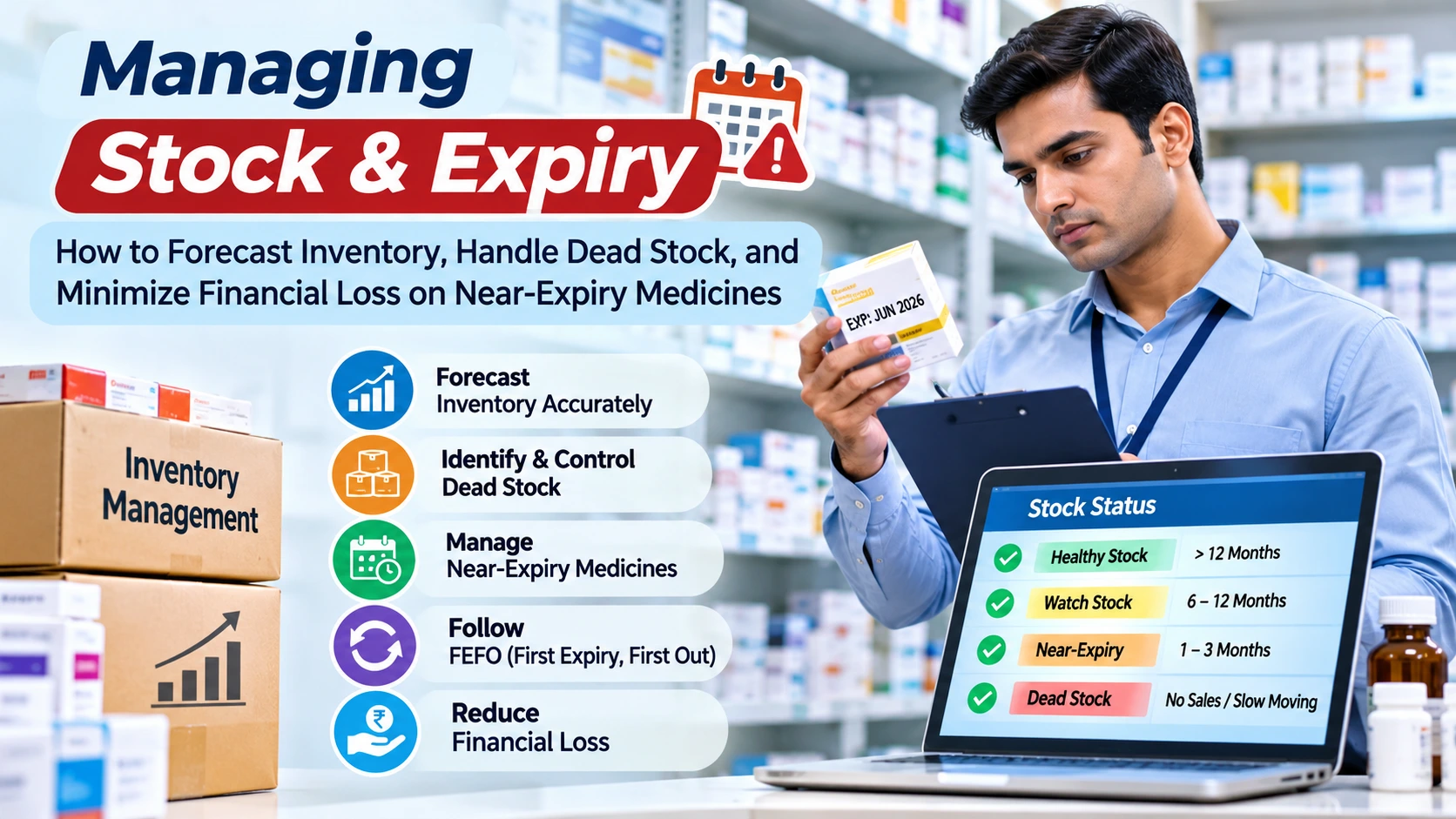
Introduction: Why Stock Management Is the Backbone of a Successful Pharma Business
Running a pharmaceutical business is not just about selling medicines, meeting doctors and developing a strong distribution network. There is another important aspect that often decides whether a pharma business makes a profit or struggles financially: Stock and Expiry Management.
Whether you are a Medical Representative (MR) running your own pharma marketing company, a PCD pharma franchise owner, a distributor, a stockist or a medical store owner, inventory management should be one of your top priorities.
Imagine a situation.
You invest ₹5 lakh in purchasing pharmaceutical products. Your sales are going well, doctors are prescribing your products, and distributors are placing orders. Everything seems perfect. However, after six months, you discover that nearly ₹75,000 worth of medicines are lying unsold in your warehouse. Some products have only two or three months of shelf life remaining, while others have already become slow-moving items.
Suddenly, your working capital is blocked, your profit margin starts shrinking, and you are forced to accept financial losses.
Unfortunately, this is a common problem in the pharmaceutical industry.
The good news is that most inventory-related losses can be controlled through proper planning, regular monitoring, accurate demand forecasting and timely action.
In this article, we will explore practical ways to manage pharmaceutical inventory, identify dead stock, forecast demand and minimize financial losses caused by near-expiry medicines.
1. Understand the Importance of Stock Management in the Pharma Industry
Stock management means maintaining the right quantity of products at the right time without blocking unnecessary money in inventory.
In pharmaceutical distribution, inventory management becomes particularly important because medicines have limited shelf lives and specific storage requirements.
Unlike many other businesses, pharmaceutical products cannot simply remain in a warehouse indefinitely.
Every medicine has:
A manufacturing date.
An expiry date.
A specific storage requirement.
A batch number.
A defined demand pattern.
A purchase and selling price.
Poor inventory management can create several problems.
Financial problems
Money gets blocked in unsold inventory.
Expired products result in financial losses.
Additional storage expenses increase.
Profit margins decrease.
Operational problems
Fast-moving products go out of stock.
Slow-moving products accumulate.
Customers receive delayed supplies.
Warehouse space gets occupied unnecessarily.
Business reputation problems
Distributors, retailers and doctors expect consistent product availability. If your company frequently fails to supply products, customers may gradually shift towards competitors.
Therefore, effective stock management is not simply a warehouse activity. It is an essential business strategy.
2. Classify Your Pharmaceutical Products According to Sales Performance
One of the easiest ways to improve inventory management is to divide your products into different categories.
Every product does not have the same sales potential.
Some products sell daily, some sell occasionally, and others may remain unsold for months.
A. Fast-Moving Products
These are products with regular and consistent demand.
Examples:
Commonly prescribed antibiotics.
Frequently sold pain-relief products.
Regularly prescribed multivitamins.
Popular gastrointestinal products.
Management strategy: Maintain sufficient stock and monitor weekly sales. Avoid unnecessary stockouts.
B. Slow-Moving Products
These products generate occasional sales but do not have consistent demand.
Examples:
Specialised formulations.
Certain paediatric combinations.
Niche therapeutic products.
Management strategy: Purchase in smaller quantities and review demand before placing fresh orders.
C. Non-Moving or Dead Stock
These products have not recorded sales for a considerable period.
Possible reasons include:
Low doctor prescription demand.
Changes in treatment preferences.
Poor market acceptance.
Excessive purchasing.
Strong competition.
Management strategy: Identify these products early, stop unnecessary replenishment and investigate whether returns or replacements are possible.
A simple classification table can help:
| Stock category | Suggested monitoring | Action |
|---|---|---|
| Fast-moving | Weekly | Maintain optimum stock |
| Slow-moving | Fortnightly | Reduce purchasing |
| Non-moving | Monthly | Review and take corrective action |
| Near-expiry | Weekly | Initiate return or stock recovery |
| Expired | Immediately | Segregate and arrange compliant disposal |
3. How to Forecast Inventory Requirements Accurately
Inventory forecasting means estimating how much stock you will need in the coming weeks or months.
Many pharma businesses make the mistake of purchasing products based on assumptions rather than actual sales data.
For example, a distributor receives an attractive purchase scheme from a company and purchases 100 boxes instead of the usual 30 boxes.
The scheme may appear profitable initially, but if the market demand is insufficient, the additional stock can eventually become a liability.
Method 1: Use Historical Sales Data
Check your previous three to six months of sales.
For example:
| Month | Product A sales |
|---|---|
| January | 100 units |
| February | 120 units |
| March | 110 units |
| April | 130 units |
| May | 120 units |
| June | 140 units |
Average monthly sales:
(100 + 120 + 110 + 130 + 120 + 140) ÷ 6 = 120 units.
Based on this information, your average monthly demand is approximately 120 units.
You can use this figure as a starting point for future purchasing decisions.
However, always consider seasonal demand, new doctor prescriptions, competitor activity and market changes.
Method 2: Maintain Minimum and Maximum Stock Levels
Every product should have a predefined minimum and maximum stock level.
For example:
Minimum stock: 40 units.
Maximum stock: 150 units.
Average monthly sales: 100 units.
When stock approaches the minimum level, place a replenishment order after considering supplier lead time and pending orders.
This avoids both overstocking and stock shortages.
Method 3: Calculate Safety Stock
Safety stock is additional inventory maintained to protect against unexpected demand or supplier delays.
A basic formula is:
Safety Stock = Maximum Daily Sales × Maximum Lead Time − Average Daily Sales × Average Lead Time
For example:
Maximum daily sales: 8 units.
Maximum delivery time: 7 days.
Average daily sales: 5 units.
Average delivery time: 5 days.
Safety stock = (8 × 7) − (5 × 5)
Safety stock = 31 units.
This means you may maintain approximately 31 additional units as a buffer, subject to the product's shelf life and storage requirements.
Do not apply the same safety stock formula blindly to every product. For slow-moving medicines, a large buffer can create expiry losses.
4. Follow FEFO: First Expiry, First Out
One of the most important principles of pharmaceutical stock management is FEFO.
FEFO stands for First Expiry, First Out.
It means that the product batch with the earliest expiry date should be dispatched first, irrespective of when it was purchased.
For example:
You have two batches of the same medicine.
| Batch | Quantity | Expiry |
|---|---|---|
| Batch A | 100 units | March 2027 |
| Batch B | 150 units | September 2027 |
Even if Batch B was received earlier, Batch A should normally be dispatched first because it has a shorter remaining shelf life.
Why is FEFO important?
Reduces expiry-related losses.
Improves warehouse organisation.
Prevents older batches from remaining unnoticed.
Helps maintain product quality.
Makes stock rotation easier.
Your warehouse team should clearly identify batches and arrange them so that the earliest-expiring products are easily accessible.
FEFO should also be supported by your billing and inventory software.
5. How to Identify and Control Dead Stock
Dead stock is one of the biggest hidden financial problems in pharma distribution.
It refers to products that remain unsold for a long period and have little or no expected demand.
The problem is that many business owners identify dead stock only when they conduct their annual stock audit.
By that time, the opportunity to recover the investment may already have disappeared.
How to identify dead stock
Prepare a monthly report containing:
Product name.
Batch number.
Available quantity.
Purchase value.
Last sale date.
Average monthly sales.
Expiry date.
For example:
| Product | Stock | Last sale | Status |
|---|---|---|---|
| Product A | 100 | 10 days ago | Active |
| Product B | 75 | 3 months ago | Slow |
| Product C | 150 | 8 months ago | Non-moving |
What should you do with dead stock?
1. Stop fresh purchasing
Do not purchase more quantities of products that are already lying unsold.
2. Identify the reason for poor sales
Check whether the problem is related to pricing, product quality, doctor acceptance, competition or market demand.
3. Contact the supplier or manufacturer
Ask whether stock return, replacement, exchange or credit-note facilities are available under the applicable agreement and policy.
4. Review your product portfolio
Remove products that consistently fail to generate demand.
5. Monitor the stock more frequently
Do not wait until products become near-expiry before taking action.
6. Managing Near-Expiry Medicines: The Most Critical Activity
Near-expiry inventory requires special attention because the opportunity to recover its purchase value decreases as the expiry date approaches.
A common mistake is to wait until the last month before contacting the manufacturer or supplier.
By then, retailers may refuse the stock, return windows may have closed, and the possibility of replacement may be limited.
The solution is to create an organised expiry-monitoring system.
Create expiry-based stock categories
You can divide inventory into the following practical categories:
| Remaining shelf life | Stock status | Recommended action |
|---|---|---|
| More than 12 months | Healthy | Normal sales and monitoring |
| 6–12 months | Watch | Review demand and purchasing |
| 3–6 months | Attention | Contact supplier and assess returns |
| 1–3 months | Critical | Immediate recovery action |
| Expired | Non-saleable | Segregate and arrange compliant disposal |
These are suggested internal monitoring bands, not statutory expiry classifications. Adjust them according to product shelf life, customer acceptance and manufacturer return policies.
What to do when medicines are nearing expiry?
Step 1: Prepare a near-expiry report
Generate a report every month showing all batches with less than six months of remaining shelf life.
Step 2: Calculate the financial exposure
For each batch, calculate:
Quantity × Purchase price per unit = Stock value at risk.
For example:
Product: XYZ Tablets.
Quantity: 500 strips.
Purchase price: ₹30 per strip.
Remaining shelf life: 3 months.
Total stock value = ₹15,000.
This tells you exactly how much money is at risk.
Step 3: Contact the manufacturer or supplier
Check the company's expiry return policy and submit the claim within the prescribed window.
Step 4: Coordinate with retailers
Where permitted and appropriate, coordinate timely returns from retailers so the stock can move through the authorised supply chain for return processing.
Step 5: Follow up on replacement or credit notes
Maintain records of all claims and their settlement status.
Important: Never sell or distribute expired medicines. Near-expiry medicines must also be supplied only where they remain within their labelled shelf life, meet applicable storage and quality requirements, and have sufficient remaining shelf life for the intended customer and use.
7. Develop a Strong Expiry Return Policy with Manufacturers
If you are operating a PCD pharma franchise, marketing company or distribution business, expiry return terms should be discussed before placing your first purchase order.
Different manufacturers have different policies.
Some may offer replacement, some may issue credit notes, while others may have specific limitations.
Before finalizing a supplier, ask:
What percentage of expired stock is eligible for return?
Is near-expiry stock eligible for replacement?
How many months before expiry must a claim be submitted?
Is the original purchase invoice required?
Are products damaged during storage covered?
How long does the company take to settle claims?
Are replacement products or credit notes provided?
Always obtain the policy in writing.
A favourable expiry return arrangement can protect your working capital and reduce business risk.
8. Use Technology to Manage Pharma Inventory
Manual stock registers and Excel sheets may work when your business is small.
However, as your business grows, managing hundreds of products, batches and expiry dates manually becomes difficult.
A pharmaceutical inventory management system can make this process significantly easier.
Essential features of pharma inventory software
Batch-wise stock management
Every product should have a separate record for each batch.
Expiry date tracking
The system should automatically identify batches approaching expiry.
Automatic alerts
Generate notifications for products nearing expiry at 6 months, 3 months and 1 month.
FEFO-based billing
The software should suggest the earliest-expiring eligible batch during billing.
Purchase and sales analysis
Identify fast-moving, slow-moving and non-moving products.
Stock valuation
Calculate the value of available inventory and identify capital blocked in unsold stock.
Supplier return management
Maintain expiry claims, return quantities, credit notes and replacement records.
Multiple warehouse management
If your business operates in multiple locations, track stock separately for each warehouse.
Excel versus Pharma Inventory Software
| Feature | Excel | Pharma Software |
|---|---|---|
| Basic stock entry | Yes | Yes |
| Batch tracking | Manual | Automated |
| Expiry alerts | Requires setup | Automated |
| FEFO management | Manual | Can be automated |
| Sales forecasting | Formula-based | Advanced reports |
| Return tracking | Manual | Integrated |
| Multiple warehouses | Difficult | Easier |
Technology is not necessarily an expensive investment. Even a well-designed Excel inventory tracker can be a good starting point for a small business.
9. Important Financial Calculations Every Pharma Business Owner Should Know
To control inventory losses, business owners should monitor a few important financial indicators.
A. Inventory Turnover Ratio
This ratio indicates how frequently your inventory is sold and replaced.
Formula:
Inventory Turnover Ratio = Cost of Goods Sold ÷ Average Inventory Value.
A higher turnover generally indicates better stock movement, although the ideal ratio varies across products and business models.
B. Expiry Loss Percentage
This tells you how much of your business revenue is being lost due to expired products.
Formula:
Expiry Loss % = Value of Expired Stock ÷ Total Sales × 100.
Example:
Total monthly sales: ₹10,00,000.
Expiry loss: ₹20,000.
Expiry loss percentage = 2%.
Your objective should be to reduce this percentage through better forecasting and timely returns.
C. Inventory Holding Cost
Stock does not come free of cost after purchasing.
You also spend money on:
Warehouse rent.
Electricity.
Staff salaries.
Insurance.
Handling.
Financing costs.
Excessive inventory increases these expenses and reduces profitability.
D. Working Capital Blockage
Calculate how much money is lying in slow-moving and near-expiry products.
This figure will help you understand how much working capital could be released through better purchasing and stock rotation.
10. Practical Example: How a Pharma Distributor Can Save ₹1 Lakh
Consider a distributor with the following inventory:
| Category | Stock value |
|---|---|
| Fast-moving products | ₹3,00,000 |
| Slow-moving products | ₹1,00,000 |
| Near-expiry products | ₹1,50,000 |
| Non-moving products | ₹50,000 |
| Total inventory | ₹6,00,000 |
The distributor introduces a monthly stock review system.
After reviewing the inventory:
₹30,000 worth of near-expiry stock is returned under the supplier's applicable policy.
₹20,000 worth of non-moving stock is exchanged for faster-moving products.
₹50,000 of unnecessary future purchases is avoided.
The business has potentially protected ₹1 lakh of cash or inventory value.
This is not an additional sale. It is money saved by making better inventory decisions.
That is why inventory management directly contributes to profitability.
11. Common Stock Management Mistakes to Avoid
Even experienced pharma business owners make inventory mistakes.
Here are some common ones:
Buying only to achieve purchase schemes
A bulk purchase discount is not always a profit. If the products remain unsold, the scheme can turn into a loss.
Ignoring batch numbers
Two batches of the same medicine may have different expiry dates. Always maintain batch-wise records.
Not checking expiry at the time of purchase
Verify the remaining shelf life before accepting a consignment, according to your agreed purchasing requirements.
Waiting until expiry to claim returns
Submit claims within the manufacturer's prescribed timeline.
Keeping dead stock for too long
Unused inventory blocks working capital that could be invested in better-selling products.
Not conducting physical stock audits
Software records should periodically be matched against actual warehouse quantities.
Ignoring storage conditions
Incorrect temperature, humidity or handling can damage medicines even before their printed expiry date.
12. A Monthly Inventory Management Checklist for Pharma Business Owners
Make inventory management a regular business activity rather than an occasional exercise.
Every month, complete the following tasks:
Check total available stock.
Prepare batch-wise expiry reports.
Identify products with less than six months of shelf life.
Review products with no sales in the last 90 days.
Calculate slow-moving and dead stock value.
Compare actual sales with forecasted sales.
Review pending manufacturer expiry claims.
Verify physical stock against software records.
Check storage conditions.
Stop unnecessary purchases.
Prepare the next month's purchase plan.
Review inventory turnover and expiry losses.
A simple monthly discipline can prevent many avoidable losses.
13. Special Advice for Pharma MRs Starting Their Own Business
If you are a Medical Representative planning to start your own pharma marketing company or PCD franchise, pay particular attention to inventory management from the beginning.
Your initial investment may be limited, so every rupee matters.
Here are a few practical suggestions:
Start with a focused product portfolio instead of purchasing 100 products immediately.
Study the prescription potential of your territory.
Maintain regular communication with doctors and retailers to understand genuine market demand.
Purchase smaller quantities initially.
Negotiate expiry replacement terms with manufacturers.
Use Excel or inventory software from day one.
Review your stock every month.
Avoid unnecessary bulk purchasing simply to obtain additional discounts.
Keep adequate cash reserves for operating expenses.
Expand your product range only when actual demand supports it.
Remember, a successful pharma business is not built by purchasing more medicines. It is built by selling the right medicines, at the right time, with proper stock control.
Conclusion: Better Inventory Management Means Better Business Profitability
In the pharmaceutical industry, stock management is directly connected with business profitability.
A company may generate impressive sales figures, but if a significant portion of its investment remains blocked in dead stock or is lost through expired medicines, its actual profitability will suffer.
The most successful pharma distributors and marketing companies understand that purchasing, selling, forecasting and expiry monitoring must work together.
Start with simple practices:
Forecast demand using actual sales data.
Follow FEFO principles.
Identify dead stock early.
Monitor near-expiry batches every month.
Maintain written expiry return policies.
Use technology to automate stock monitoring.
Review inventory performance regularly.
You do not need a large warehouse or expensive software to begin. You need a disciplined system and the willingness to review your stock regularly.
Remember: In the pharma business, profit is not only earned when you sell a product. Profit is also protected when you prevent that product from becoming dead stock.
Frequently Asked Questions (FAQs)
Q1. What is the best method for managing pharmaceutical inventory?
FEFO (First Expiry, First Out), combined with batch-wise tracking, accurate demand forecasting and regular stock audits, is an effective approach.
Q2. How often should pharma distributors check expiry dates?
A monthly expiry review is a good minimum practice. Products approaching expiry should be monitored more frequently, preferably weekly.
Q3. What is dead stock in the pharmaceutical industry?
Dead stock refers to medicines that remain unsold for an extended period and have little or no expected demand.
Q4. Can near-expiry medicines be sold?
Medicines that have not expired may be supplied subject to applicable quality, storage, labelling and customer requirements. Expired medicines must never be sold or distributed.
Q5. Can pharmaceutical companies accept expired medicines from distributors?
India's CDSCO guidance on disposal of expired and unused medicines, dated 26 May 2025, addresses responsibilities for accepting and handling returned expired or unused drugs across the supply chain. Businesses should follow the applicable guidance and regulatory requirements, maintain proper records and coordinate with their authorised suppliers.
Q6. Which software is useful for pharma stock management?
Pharmaceutical inventory software with batch tracking, FEFO, expiry alerts, stock valuation, sales analysis and return management can be useful. Small businesses can initially use a properly designed Excel tracker.
Q7. How can a small PCD pharma company reduce expiry losses?
Start with limited quantities, select products based on market demand, negotiate written expiry return policies and monitor every batch regularly.