Introduction: Is Ayurveda Becoming the Next Big Opportunity in the Pharma Business?
Walk into a pharmacy, visit a wellness store or browse an online healthcare platform today, and you will notice something interesting. Alongside conventional medicines, there is increasing visibility of Ayurvedic formulations, herbal supplements, plant-based products and traditional wellness solutions.
Consumers are showing interest in traditional healthcare systems, natural ingredients and wellness-oriented lifestyles. From herbal juices and digestive formulations to Ayurvedic immunity products, skincare preparations and nutritional supplements, the market has expanded into several product categories.
This changing consumer interest is creating new business opportunities for pharmaceutical entrepreneurs.
For someone already working in the pharmaceutical industry, particularly a Medical Representative (MR), PCD pharma franchise owner or distributor, entering the Ayurvedic and herbal segment can be an interesting business expansion.
Imagine having an existing network of chemists, doctors, distributors and retailers. Instead of limiting your business to conventional pharmaceutical products, you could gradually introduce a separate Ayurvedic product portfolio.
You could build a brand around traditional herbal formulations, Ayurvedic healthcare products and wellness categories while using your existing distribution experience.
However, starting an Ayurvedic business requires more than simply selecting a few herbal ingredients and putting them into attractive packaging. Product quality, manufacturing standards, licensing, branding, market research and regulatory compliance are equally important.
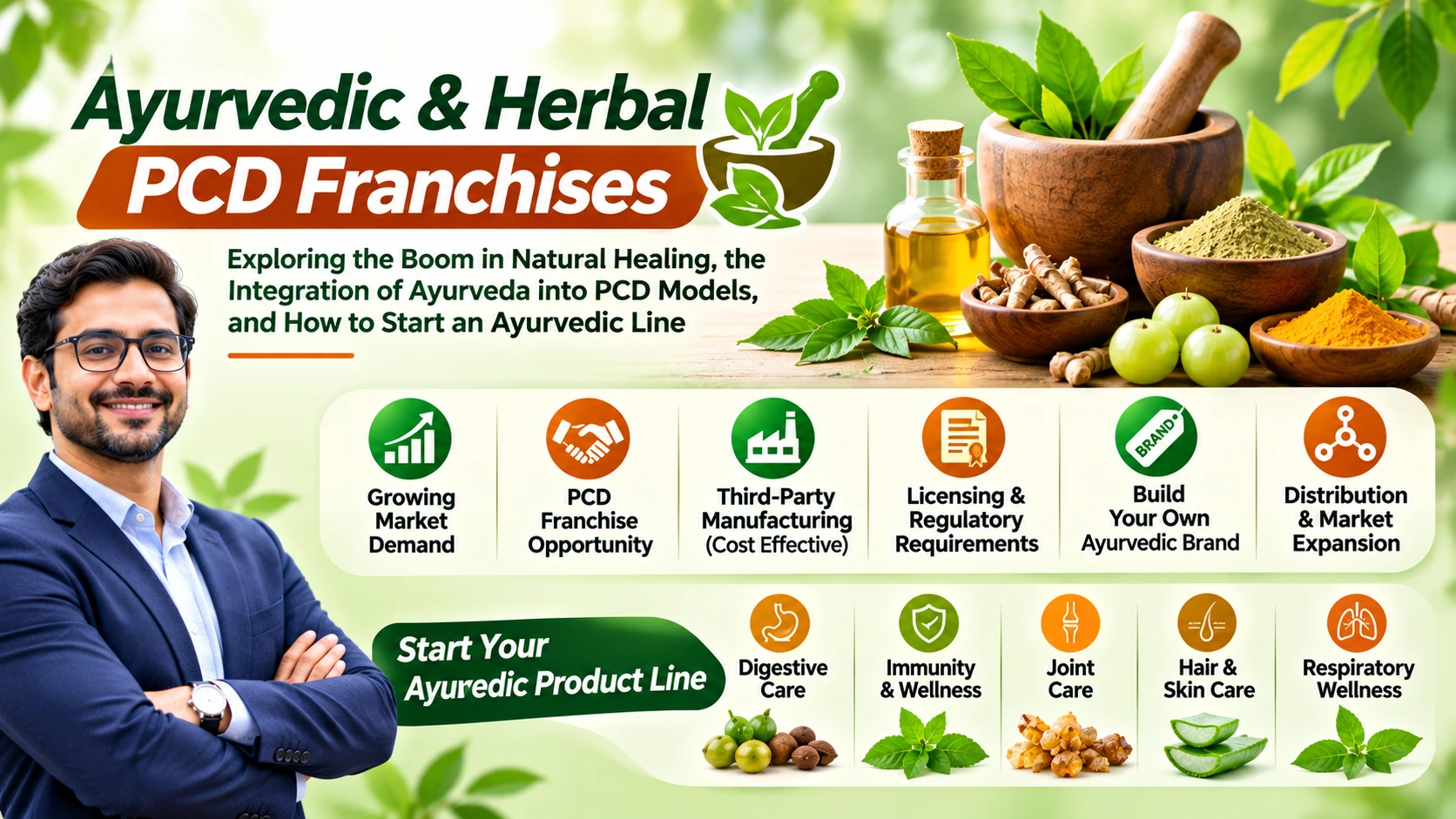
In this article, we will explore the growing Ayurvedic market, different PCD business models, popular product categories and a practical roadmap for launching your own Ayurvedic product line in India.
1. Understanding the Growing Demand for Ayurveda and Herbal Products in India
Ayurveda is not a new concept in India. It has been part of traditional Indian healthcare and wellness practices for centuries.
What is changing today is the way Ayurvedic products are being manufactured, branded, distributed and marketed.
Earlier, many consumers purchased traditional formulations from local Ayurvedic stores or practitioners. Today, organised brands are introducing professionally packaged products through pharmacies, retail outlets, wellness centres and digital platforms.
Several factors are contributing to this development.
A. Growing Interest in Traditional Healthcare
Many consumers are exploring traditional healthcare systems alongside modern healthcare.
They are interested in familiar ingredients such as:
Ashwagandha.
Amla.
Giloy.
Tulsi.
Neem.
Triphala.
Shatavari.
Turmeric.
Brahmi.
However, natural origin does not automatically mean that a product is safe or suitable for everyone. Product quality, dosage, interactions and individual health requirements still matter.
B. Increasing Focus on Preventive Wellness
Consumers are paying greater attention to everyday wellness, nutrition, digestion, sleep, fitness and healthy ageing.
This has created opportunities for products positioned around general wellness, subject to their correct regulatory classification and permitted claims.
C. Growth of the Organised AYUSH Sector
Government-reported figures also demonstrate the growing economic importance of this sector.
According to a September 2026 Ministry of Ayush announcement, a study by the Research and Information System for Developing Countries estimated the Indian AYUSH services economy at US$36.92 billion in FY2024–25.
The study also identified Ayurveda as the largest individual system within the AYUSH services economy, accounting for approximately US$17.73 billion. <Cite refs={["turn221214search0","turn221214search2"]}/>
India's exports of AYUSH and herbal products also increased from approximately ₹3,997 crore in FY2020–21 to ₹5,831 crore in FY2024–25, according to a government-reported Exim Bank analysis. <Cite refs={["turn221214search37","turn221214search9"]}/>
These figures relate to the wider AYUSH economy and exports, not specifically the PCD franchise market. Nevertheless, they indicate the growing commercial importance of traditional healthcare and herbal products.
D. Digital Platforms Are Expanding Product Reach
Websites, online pharmacies, social media and digital business directories have made it easier for consumers to discover herbal brands.
Smaller companies can now build brand visibility without establishing a large physical retail network from day one.
For new entrepreneurs, this creates opportunities to enter selected geographical markets with a focused product range.
2. What Is an Ayurvedic PCD Pharma Franchise?
An Ayurvedic PCD franchise is a business arrangement in which an Ayurvedic product manufacturer or marketing company appoints an individual or business partner to market and distribute its products in a specified territory.
PCD generally stands for Propaganda Cum Distribution.
The business partner may receive certain marketing and distribution rights according to the agreement.
For example:
Suppose you want to start an Ayurvedic business in Chandigarh, Mohali or Panchkula.
Instead of establishing your own manufacturing facility, you approach an established Ayurvedic manufacturer that offers PCD franchise opportunities.
You select products from its approved portfolio, negotiate commercial terms and develop a distribution network in your territory.
The manufacturer handles production, while you focus on marketing, sales, distribution and customer relationships.
Key features of an Ayurvedic PCD franchise
Lower manufacturing investment.
Access to an existing product portfolio.
Opportunity to work under a selected brand.
Potential for territory-based distribution rights.
Manufacturer support, depending on the agreement.
Scope to develop a local retailer and distributor network.
Why is this model attractive?
The biggest advantage is that you do not need to establish a manufacturing plant.
You can concentrate on understanding the market, developing business relationships and building sales.
However, the quality of the manufacturer and the commercial terms of the agreement will directly influence your business performance.
3. Ayurvedic PCD vs Conventional Pharma PCD: What Is the Difference?
Both models follow similar distribution principles, but their product categories, consumer positioning and regulatory requirements can differ.
| Parameter | Conventional Pharma PCD | Ayurvedic PCD |
|---|---|---|
| Product category | Modern pharmaceutical medicines | Ayurvedic medicines and formulations |
| Product approach | Approved pharmaceutical formulations | Traditional Ayurvedic formulations |
| Target market | Doctors, hospitals, pharmacies | Relevant practitioners, pharmacies, wellness outlets and consumers |
| Branding | Pharmaceutical positioning | Traditional healthcare and wellness positioning |
| Manufacturing | Pharmaceutical manufacturing facilities | Appropriately licensed ASU manufacturing facilities |
| Market education | Clinical product information | Formulation, traditional indications and permitted product information |
| Business opportunity | Acute and chronic-care portfolios | Ayurvedic healthcare and wellness portfolios |
One important point: Ayurvedic medicines and nutraceutical products are not automatically the same regulatory category.
An Ayurvedic medicine manufactured under the applicable ASU drug framework has different requirements from a food supplement regulated under FSSAI.
The classification must be established before selecting a manufacturer or developing a product.
4. Which Ayurvedic and Herbal Products Can You Launch?
One of the biggest advantages of the Ayurvedic segment is the variety of product categories available.
However, a new business should not try to launch everything simultaneously.
Start with products that have genuine market demand, reliable manufacturing support and a clear regulatory classification.
Here are some categories worth researching.
A. General Wellness and Herbal Products
<PRIVATE_PERSON>Many consumers are interested in everyday wellness products and traditional herbal formulations.
Possible categories include:
Amla-based formulations.
Herbal digestive products.
Traditional wellness preparations.
Ashwagandha-based formulations.
Triphala-based products.
Herbal powders and juices.
These products may appeal to customers interested in traditional wellness, depending on the formulation and permitted positioning.
B. Ayurvedic Digestive Care
Digestive wellness is a familiar category in the Indian market.
Possible products include:
Triphala-based preparations.
Digestive churnas.
Herbal digestive syrups.
Traditional formulations for digestive wellness.
This category may be suitable for companies already serving general pharmacies and healthcare retail outlets.
C. Herbal Liver and Digestive Wellness
Products based on traditional herbal ingredients such as Bhumyamalaki and Kutki are found in the Ayurvedic market.
Possible formulations include:
Ayurvedic liver-care products.
Herbal digestive formulations.
Traditional liver-support preparations.
Any disease-related claims must be supported and permitted under the applicable product licence and advertising framework.
D. Ayurvedic Hair and Skin Care
The beauty and personal-care market offers another opportunity.
Possible product categories include:
Herbal hair oils.
Ayurvedic shampoos.
Herbal skin creams.
Neem-based skincare.
Aloe vera preparations.
Herbal face washes.
Depending on the formulation and intended use, these products may be regulated as cosmetics, ASU drugs or other product categories.
Correct classification is essential.
E. Ayurvedic Joint and Musculoskeletal Wellness
Traditional formulations containing ingredients such as Ashwagandha, Shallaki and Nirgundi are present in the Ayurvedic market.
Potential product categories include:
Ayurvedic massage oils.
Traditional joint-care formulations.
Herbal massage preparations.
Selected classical Ayurvedic products.
Avoid unsupported claims that a product cures arthritis or permanently eliminates joint pain.
F. Women's Wellness
Women's wellness is another area where traditional herbal formulations are available.
Products may include selected formulations based on Shatavari and other traditionally used ingredients.
This category requires particular care in product selection, safety information, pregnancy-related precautions and marketing claims.
G. Ayurvedic Respiratory and Seasonal Wellness
Products based on Tulsi, Vasaka, Mulethi and other traditional ingredients are available in the market.
Potential formats include:
Herbal syrups.
Traditional herbal formulations.
Herbal lozenges.
Ayurvedic preparations for respiratory wellness.
The product's actual classification, approved indication and advertising permissions must be checked before launch.
5. How to Integrate Ayurveda into Your Existing PCD Pharma Business
If you already operate a conventional PCD pharma franchise or pharma marketing company, you may not need to establish an entirely new distribution network.
You can evaluate Ayurveda as an additional business vertical.
However, it should be introduced carefully.
Step 1: Study Your Existing Customer Network
Look at your current business relationships.
Identify:
Pharmacies.
Ayurvedic practitioners.
Wellness centres.
Ayurvedic clinics.
Distributors.
Retail outlets.
Understand which customers are interested in adding Ayurvedic products to their existing business.
Step 2: Develop a Separate Ayurvedic Product Portfolio
Avoid mixing different product categories without proper classification.
Create a dedicated product portfolio with:
Separate product information.
Clear regulatory classification.
Manufacturer details.
Applicable licence information.
Product-specific labelling.
Approved claims and usage information.
Step 3: Use Your Existing Distribution Strength
Your existing chemist network may help you introduce suitable Ayurvedic products.
However, do not assume that every conventional pharmacy customer will automatically become an Ayurvedic customer.
Market research is essential.
Step 4: Train Your Sales Representatives
Your sales team should understand the difference between conventional medicines, Ayurvedic medicines, nutraceuticals and cosmetics.
They should also know the permitted product claims and relevant precautions.
Step 5: Monitor Business Performance Separately
Track the Ayurvedic business as an independent vertical.
Measure:
Product-wise sales.
Territory-wise demand.
Distributor performance.
Stock movement.
Expiry exposure.
Customer feedback.
Collection efficiency.
This will help you understand whether the new business is actually adding value.
6. How to Start Your Own Ayurvedic Product Line in India
If you want to move beyond a franchise and establish your own Ayurvedic brand, there are two major approaches.
Model 1: Third-Party Manufacturing
This is generally the more practical option for a new entrepreneur.
You develop your own brand and get products manufactured through an appropriately licensed third-party Ayurvedic manufacturer.
For example:
You register a company called ABC Herbal Healthcare.
You select five products from a qualified manufacturer and launch them under your own brand, subject to the applicable product and manufacturing permissions.
Your company focuses on:
Brand development.
Product selection.
Marketing.
Distribution.
Sales.
Customer relationships.
The manufacturer handles production under the relevant licensing arrangement.
Advantages:
No need to establish a factory.
Lower initial infrastructure investment.
Faster market entry, depending on approvals and arrangements.
Opportunity to develop a unique brand identity.
Ability to expand the product range gradually.
However, having a brand name or trademark does not automatically authorise you to manufacture or market every category of healthcare product. The appropriate licence, product permissions and manufacturing arrangement must be in place.
Model 2: Establish Your Own Ayurvedic Manufacturing Unit
If you have sufficient investment and long-term plans, you may consider setting up your own manufacturing facility.
This model offers greater control over:
Manufacturing operations.
Product development.
Production planning.
Quality management.
Packaging.
Supply chain.
However, it also involves significantly higher costs.
You will need suitable premises, manufacturing equipment, qualified technical personnel, quality-control arrangements and the relevant manufacturing licence.
For most first-time entrepreneurs, third-party manufacturing is worth evaluating before investing in their own factory.
7. Legal Requirements for Starting an Ayurvedic Product Business
This is one of the most important sections of the entire business plan.
Many new entrepreneurs believe that herbal products can be manufactured and sold without significant regulatory requirements.
That is incorrect.
Ayurvedic medicines are regulated under the Drugs and Cosmetics Act, 1940 and the Drugs Rules, 1945.
Important requirements to consider
1. Business Registration
Choose an appropriate business structure:
Proprietorship.
Partnership.
LLP.
Private Limited Company.
The right structure depends on ownership, investment and business plans.
2. GST Registration
Determine your GST registration and invoicing obligations based on the applicable tax rules and business structure.
3. Manufacturing Licence
Ayurvedic, Siddha and Unani medicines require the appropriate manufacturing licence from the relevant State Licensing Authority.
For Ayurvedic and other ASU medicines, Schedule T of the Drugs Rules provides the applicable GMP requirements.
4. Product Approval and Documentation
Ensure that the products being manufactured are permitted under the relevant regulatory framework.
Check:
Product formulation.
Ingredients.
Manufacturing documentation.
Applicable standards.
Product licence or approval.
Labelling requirements.
5. Trademark Registration
Register your brand name and logo in the appropriate trademark class after conducting a proper availability search.
6. Packaging and Labelling
Ensure that the product packaging contains all mandatory declarations applicable to its category.
These may include:
Product name.
Ingredients or composition.
Batch number.
Manufacturing date.
Expiry or best-before information, as applicable.
Manufacturer details.
Manufacturing licence details.
Applicable directions and warnings.
7. FSSAI Requirements Where Applicable
If your product is classified as a food or health supplement rather than an Ayurvedic drug, the applicable FSSAI requirements need to be followed.
Do not assume that an FSSAI registration can replace an AYUSH drug manufacturing licence or vice versa.
Important note on advertising claims
The regulatory position on Rule 170 of the Drugs Rules has been subject to litigation. The Ministry of Ayush reported in 2025 that the Supreme Court had stayed the notification omitting the rule, pending further orders.
Therefore, advertising requirements must be checked against the latest applicable legal position before publishing promotional material. <Cite refs={["turn221214search35","turn221214search5"]}/>
The Ministry of Ayush has also reiterated the importance of manufacturing licences, GMP compliance under Schedule T and prescribed pharmacopoeial quality standards. <Cite refs={["turn221214search1","turn221214search4"]}/>
For a new business, it is advisable to consult a regulatory professional or the relevant State Licensing Authority before finalising product formulations, labels and marketing claims.
8. How to Select the Right Ayurvedic Third-Party Manufacturer
Your manufacturer is one of the most important business partners.
A poorly selected manufacturer can create problems with product quality, delivery, documentation and customer confidence.
Before signing an agreement, consider the following points.
Manufacturing credentials
Valid manufacturing licence.
Applicable GMP compliance.
Appropriate manufacturing infrastructure.
Qualified technical staff.
Quality-control facilities.
Product quality
Approved formulations.
Ingredient specifications.
Batch testing arrangements.
Stability information.
Proper documentation.
Traceability of raw materials.
Commercial terms
Minimum order quantity.
Product manufacturing cost.
Packaging cost.
Branding charges.
Payment terms.
Production lead time.
Freight arrangements.
Business support
Product documentation.
Packaging assistance.
Regulatory coordination.
Batch-related support.
Complaint handling.
Expiry and return policy, where agreed.
Never select a manufacturer only because it offers the lowest price.
In healthcare products, product quality and regulatory compliance should come before short-term cost savings.
9. Branding: How to Build a Strong Ayurvedic Brand
The Ayurvedic market is competitive.
Simply putting a leaf symbol on a product and using the word "Herbal" is not enough to build a successful brand.
Your brand needs a clear identity.
A. Choose a Memorable Brand Name
The name should be:
Easy to pronounce.
Easy to remember.
Relevant to your product positioning.
Distinctive.
Available for trademark registration.
Conduct trademark, domain and social media availability checks before finalising the name.
B. Develop Professional Packaging
Ayurvedic packaging should communicate trust, clarity and product identity.
Consider:
Clean typography.
Appropriate colour combinations.
Clear ingredient information.
Readable labels.
Professional product photography.
Accurate regulatory declarations.
Avoid packaging that makes unsupported medical claims.
C. Build a Product Catalogue
Prepare a professional catalogue covering:
Product name.
Product category.
Dosage form.
Ingredients or composition, as permitted.
Approved indications or permitted product description.
Packaging size.
Manufacturer information.
Business contact details.
D. Establish a Digital Presence
Create:
Professional website.
Company email address.
LinkedIn company page.
Business social media profiles.
Digital company brochure.
Use educational content to explain your brand, manufacturing standards and business philosophy.
10. How to Market Ayurvedic PCD Products
Marketing an Ayurvedic product line requires a different approach from conventional pharmaceutical marketing.
The communication should focus on accurate product information, appropriate traditional context and responsible wellness education.
A. Build a Pharmacy Network
Pharmacies can be an important distribution channel for appropriately classified Ayurvedic medicines and other permitted products.
Develop relationships with:
Independent pharmacies.
Ayurvedic medicine stores.
Wellness retailers.
Relevant distributors.
Provide accurate product documentation and ensure that stock is available through authorised channels.
B. Develop Relationships with Qualified Ayurvedic Practitioners
Engage appropriately with qualified Ayurvedic practitioners through professional and compliant business activities.
Provide accurate product information and avoid misleading comparative claims.
C. Use Digital Marketing
Your digital strategy can include:
Website blogs.
Search engine optimisation.
Educational social media content.
Company introduction videos.
Product information pages.
Business enquiry forms.
All promotional content should comply with the product's regulatory category and applicable advertising rules.
D. Develop Regional Distribution
You can initially focus on one city or region.
For example:
Chandigarh.
Mohali.
Panchkula.
Zirakpur.
Kharar.
Patiala.
Ludhiana.
Build a strong local network before expanding into other territories.
E. Use Content Marketing
Useful blog topics include:
Understanding Ayurvedic Formulations.
How to Choose a Reliable Ayurvedic Manufacturer.
Difference Between Ayurvedic Medicines and Herbal Supplements.
How to Start an Ayurvedic PCD Franchise.
Importance of Quality Standards in Ayurvedic Products.
Ayurvedic Product Manufacturing in India.
Educational content can help build your company's credibility and attract relevant business enquiries.
11. Investment Required to Start an Ayurvedic PCD Business
The investment depends on your business model, number of products, manufacturing arrangement and marketing plans.
The following figures are illustrative planning estimates, not verified market quotations.
| Business model | Indicative initial investment |
|---|---|
| Small Ayurvedic PCD franchise | ₹50,000–₹2 lakh |
| Regional Ayurvedic distribution | ₹2–5 lakh |
| Own Ayurvedic brand through third-party manufacturing | ₹3–10 lakh |
| Larger Ayurvedic marketing company | ₹10–25 lakh |
| Own manufacturing facility | Highly variable; often substantially higher |
Where will your money be spent?
For a small Ayurvedic brand using third-party manufacturing, a possible budget allocation could be:
| Expense | Illustrative budget |
|---|---|
| Product development and documentation | ₹50,000 |
| Initial manufacturing orders | ₹2,00,000 |
| Packaging and branding | ₹40,000 |
| Website and digital marketing | ₹35,000 |
| Business administration and compliance | ₹50,000 |
| Working capital reserve | ₹75,000 |
| Total | ₹4,50,000 |
Actual costs depend on the product category, regulatory classification, minimum order quantities, testing and manufacturing requirements.
Always obtain written quotations before investing.
12. Common Mistakes to Avoid in the Ayurvedic Business
Many entrepreneurs enter the herbal market because they believe natural products are easy to sell.
However, a successful business requires much more than enthusiasm.
Mistake 1: Launching Too Many Products
A new company may be tempted to launch 30–40 products immediately.
This creates unnecessary inventory and working-capital pressure.
Solution: Begin with a focused portfolio of around five to ten carefully selected products, subject to market research and regulatory readiness.
Mistake 2: Choosing a Manufacturer Without Verification
A low manufacturing price does not guarantee quality.
Solution: Verify licences, GMP compliance, documentation and product quality before placing an order.
Mistake 3: Making Unrealistic Health Claims
Statements such as "100% cure", "permanent treatment" or "no side effects" can be misleading and create serious regulatory and consumer-protection issues.
Solution: Use only accurate and legally permissible product information.
Mistake 4: Ignoring Product Classification
A herbal product may fall under different regulatory categories depending on its composition, intended use and claims.
Solution: Establish the correct category before deciding on manufacturing, packaging and marketing.
Mistake 5: Poor Inventory Management
Some products may move quickly, while others remain unsold.
Solution: Start with smaller quantities, follow FEFO stock rotation and establish written expiry-return arrangements.
Mistake 6: Depending Only on Social Media
Instagram and Facebook visibility alone will not create a sustainable distribution network.
Solution: Combine digital marketing with genuine distributor relationships, pharmacy coverage and customer service.
13. A Practical 90-Day Roadmap to Launch Your Ayurvedic Product Line
If you are planning to start an Ayurvedic business, the following roadmap can help you organise the process.
First 30 Days: Research and Planning
Study the Ayurvedic market.
Identify your target customers.
Select potential product categories.
Research competitors.
Shortlist manufacturers.
Check product classification and regulatory requirements.
Prepare a basic business plan.
Target: Finalise your business direction and initial product shortlist.
Days 31–60: Brand and Product Development
Finalise your company structure.
Select a brand name.
Conduct trademark availability checks.
Verify manufacturing credentials.
Finalise formulations and product documentation.
Decide packaging requirements.
Prepare your website and business identity.
Target: Prepare a compliant, commercially viable product launch.
Days 61–90: Launch and Market Development
Complete applicable licensing and approvals.
Place initial manufacturing orders.
Establish distributor relationships.
Prepare a product catalogue.
Start compliant digital marketing.
Approach relevant retailers and practitioners.
Track enquiries and initial sales.
Target: Build the first layer of your distribution network.
Do not rush the launch if product permissions, manufacturing documentation or quality checks are incomplete.
14. Is Ayurvedic PCD a Good Opportunity for Medical Representatives?
For an experienced Medical Representative, this business model can be worth exploring.
An MR already understands several important aspects of pharmaceutical marketing:
How to develop professional relationships.
How to understand a territory.
How to manage business follow-ups.
How to work with distributors.
How to communicate product information.
How to monitor market competition.
These skills can be useful when entering the Ayurvedic business.
However, Ayurveda requires additional product knowledge and a clear understanding of its regulatory framework.
A conventional pharmaceutical sales background alone does not make someone qualified to provide Ayurvedic medical advice.
A practical approach for MRs
If you are currently working in the pharmaceutical industry:
Start by researching the Ayurvedic product categories in your territory.
Identify reliable manufacturers.
Understand the difference between ASU medicines, nutraceuticals and cosmetics.
Select a small product portfolio.
Build relationships with relevant distributors and retailers.
Develop a separate Ayurvedic brand identity.
Expand only after establishing genuine market demand.
Your existing network may provide a starting advantage, but product quality and customer trust will determine long-term success.
15. The Future of Ayurveda: Opportunities Beyond Traditional Pharmacies
The future of the Ayurvedic industry may extend beyond conventional medicine retail.
Several additional business areas deserve attention.
A. Ayurvedic Wellness Centres
Businesses may explore partnerships with appropriately qualified practitioners and wellness establishments.
B. Herbal Personal Care
Haircare, skincare and personal-care products offer opportunities for brands with strong product development and quality systems.
C. Nutraceutical and Food Supplements
This segment has its own regulatory framework and can be explored separately from Ayurvedic medicines.
D. Online Ayurvedic Retail
Digital platforms provide opportunities to reach customers across geographical markets, subject to applicable product, advertising and e-commerce requirements.
E. Export-Oriented Ayurvedic Products
International markets may offer opportunities, but each destination has its own registration, product classification, labelling and import requirements.
F. Private-Label Herbal Products
Entrepreneurs can develop their own brands through appropriately licensed manufacturers, subject to the relevant permissions and contractual arrangements.
The important lesson is that Ayurveda is not limited to a few traditional medicines. It represents a broader business ecosystem involving healthcare, wellness, manufacturing, research, personal care and distribution.
Conclusion: Ayurveda Can Be More Than an Additional Product Range
The growing interest in traditional healthcare and herbal products is creating opportunities for entrepreneurs across India.
For existing pharma distributors, PCD franchise owners and Medical Representatives, Ayurvedic products can offer an additional business direction.
But building a successful Ayurvedic brand requires more than selecting popular herbs or attractive packaging.
It requires reliable manufacturing, appropriate licensing, quality control, realistic business planning and responsible marketing.
Start with a focused portfolio. Select your manufacturers carefully. Understand your target customers. Build your distribution network gradually and invest in a professional brand identity.
Most importantly, remember that natural products deserve the same seriousness when it comes to quality, safety and consumer trust as any other healthcare product.
The future opportunity in Ayurveda belongs not simply to those who sell herbal products, but to those who build trustworthy brands around quality, traditional knowledge and responsible business practices.
Frequently Asked Questions (FAQs)
Q1. What is an Ayurvedic PCD franchise?
An Ayurvedic PCD franchise is a business arrangement in which a company appoints a partner to market and distribute its Ayurvedic products in an agreed territory.
Q2. Can I start an Ayurvedic business without manufacturing my own products?
Yes. You can explore third-party manufacturing through an appropriately licensed manufacturer, subject to the applicable product and regulatory requirements.
Q3. How much investment is required to start an Ayurvedic PCD franchise?
A small PCD operation may be planned with approximately ₹50,000 to ₹2 lakh, while launching your own Ayurvedic brand through third-party manufacturing may require a larger investment. Actual costs depend on product selection, quantities and compliance requirements.
Q4. Which Ayurvedic products are suitable for beginners?
General wellness, digestive, personal-care and selected traditional herbal formulations may be worth researching. The best products depend on local demand, product quality and the applicable regulatory category.
Q5. Is an AYUSH licence required for Ayurvedic products?
Ayurvedic drugs require the applicable manufacturing licensing and product permissions under the Drugs and Cosmetics Act and Rules. The precise requirements depend on the product and business arrangement.
Q6. Can I launch my own Ayurvedic brand through third-party manufacturing?
Yes, this is a commonly used business model. You should verify the manufacturer's licence, applicable GMP compliance, product permissions, branding arrangements and other regulatory responsibilities.
Q7. What is the difference between Ayurvedic medicines and herbal supplements?
Ayurvedic medicines are regulated under the ASU drug framework, while food or health supplements fall under the applicable FSSAI framework. Product composition, intended use and claims help determine classification.
Q8. Can conventional pharma distributors sell Ayurvedic products?
They can explore distributing appropriately authorised products, subject to applicable licensing, storage, labelling and other regulatory requirements.
Q9. Is the Ayurvedic business profitable?
It can be profitable, but success depends on product quality, demand, manufacturing costs, distribution, pricing, working capital and customer trust. There are no guaranteed returns.
Q10. How can I find a reliable Ayurvedic third-party manufacturer?
Check manufacturing licences, GMP compliance, product documentation, quality testing, minimum order quantities, delivery commitments and written commercial agreements before selecting a manufacturer.